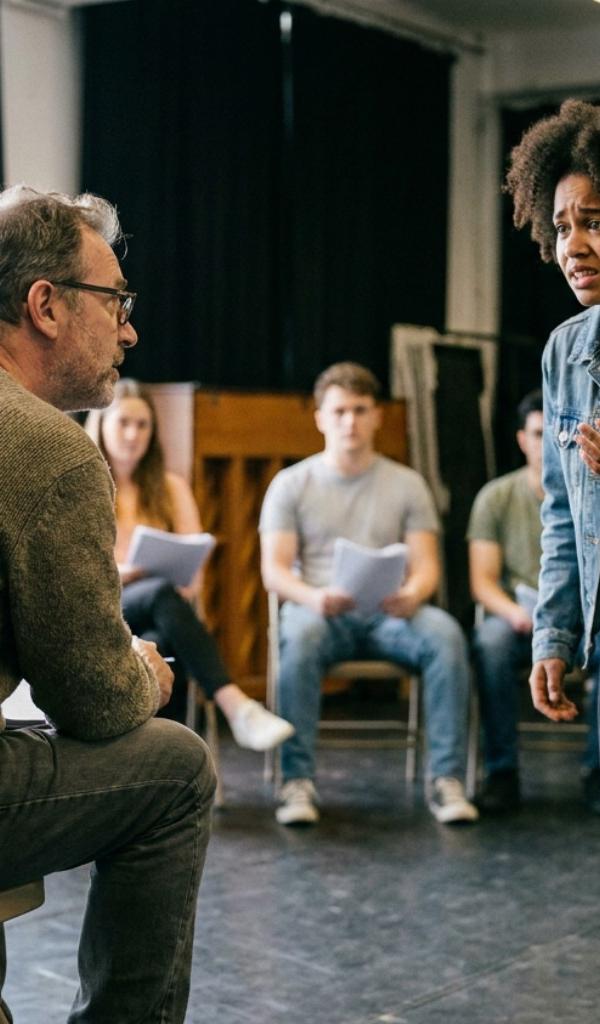

Most actors think a monologue is a memory test. It isn't. Learning how to perform a monologue is learning to do one thing under pressure: stay in a real, active relationship with an imaginary person while a stranger decides, in about ten seconds, whether they believe you. The words are the easy part. The aliveness is the job.
Here's the brutal reality of the room: a casting director has watched forty monologues today, and they can tell within two sentences whether you're living the piece or reciting it. The good news is that the thing separating "booked" from "cut" is learnable — it's craft, not luck.
The short answer: To perform a monologue, pick a piece that fits your type, break it into beats, choose a clear objective (what you're fighting to get), decide exactly who you're talking to and where they are, and start from a real "moment before." Play the other person, not the audience — and never perform the emotion; pursue the goal and let the emotion happen.
What casting is actually watching (it isn't the words)
They're watching whether there's a real human on the other end of your monologue. Is someone there? Are you trying to change them — comfort them, convince them, wound them, win them back? If the answer is yes, the room leans in. If you're just delivering beautiful lines to the middle distance, they've already moved on.
The monologue is a scene with one visible person. The invisible person is the most important part of it.
How to perform a monologue, step by step
- 1. Choose the right piece. Age-appropriate, type-appropriate, and active (someone is trying to get something). Contemporary and conversational usually beats grand and "actory." A two-minute piece you own beats a famous one you're wearing like a costume.
- 2. Break it into beats. A beat is a unit of intention that changes when your tactic changes. Mark where the character shifts approach — from pleading to threatening, from joking to confessing. Those turns are the performance.
- 3. Choose one clear objective. What do you want from the other person, right now? Not a feeling — a goal. "I want you to forgive me." "I want you to stay." Play to get it.
- 4. Place the other person. Who are they, and where exactly are they — sitting across from you, standing in the doorway, about to leave? Pick a fixed spot just off camera or just past the reader and talk to it like it's alive.
- 5. Find the moment before. What happened one second before your first line that makes you have to speak? Start full, not from zero. The best first lines land because the fire was already lit.
Beats and objectives, in plain English
Think of the objective as the engine and the beats as the gears. The objective never changes — you want the same thing the whole way through. But when one tactic fails, you shift to another, and that shift is a new beat. Charm doesn't work, so you guilt. Guilt doesn't work, so you threaten. That escalation is what makes a static speech feel like a live event.
Don't play the sad. Play the fight to not lose them — and let the sad show up on its own. Chased emotion is believable; performed emotion is not.
Where to look — and why eyeline matters on tape
For an audition or self-tape monologue, place your imaginary scene partner just to the side of the lens — close to camera, but not into it (unless the piece is a direct address). Keep your eyeline steady and specific. Wandering eyes read as "searching for the next line." A locked, living eyeline reads as "there is a real person here, and I am dealing with them."
The mistakes that get actors cut
- Performing the emotion. Pushing sadness or rage is the fastest tell of an amateur. Pursue the goal; the emotion follows.
- No one on the other end. A monologue to nobody is a recitation. Put a specific person there.
- Starting from zero. No moment before = a flat first line = a lost room.
- Choosing a piece that doesn't fit you. A brilliant monologue for the wrong type is still a miss.
- Playing it the same all the way through. No beats, no build, no reason to keep watching.
Keep reading: Comedic Monologues: How to Pick One That Actually Books You, Best Monologues From Movies for Actors in 2025, and Shakespeare Monologues: How to Make Them Play Real.
Frequently Asked Questions
How long should an audition monologue be?
Usually one to two minutes — often they'll ask for "a minute." Shorter and specific beats longer and meandering. Have a tight 60-second version and a 90-second version ready.
Should I look into the camera?
Generally no — place your scene partner just off the lens and play to them, unless the piece is written as direct address to the audience. Steady, specific eyeline over darting eyes, always.
How do I stop going blank under pressure?
Anchor the lines to the objective and the beats, not to rote memory. When you know what you want in each beat, the next line has a reason to exist — and reasons are far easier to recall than word strings.