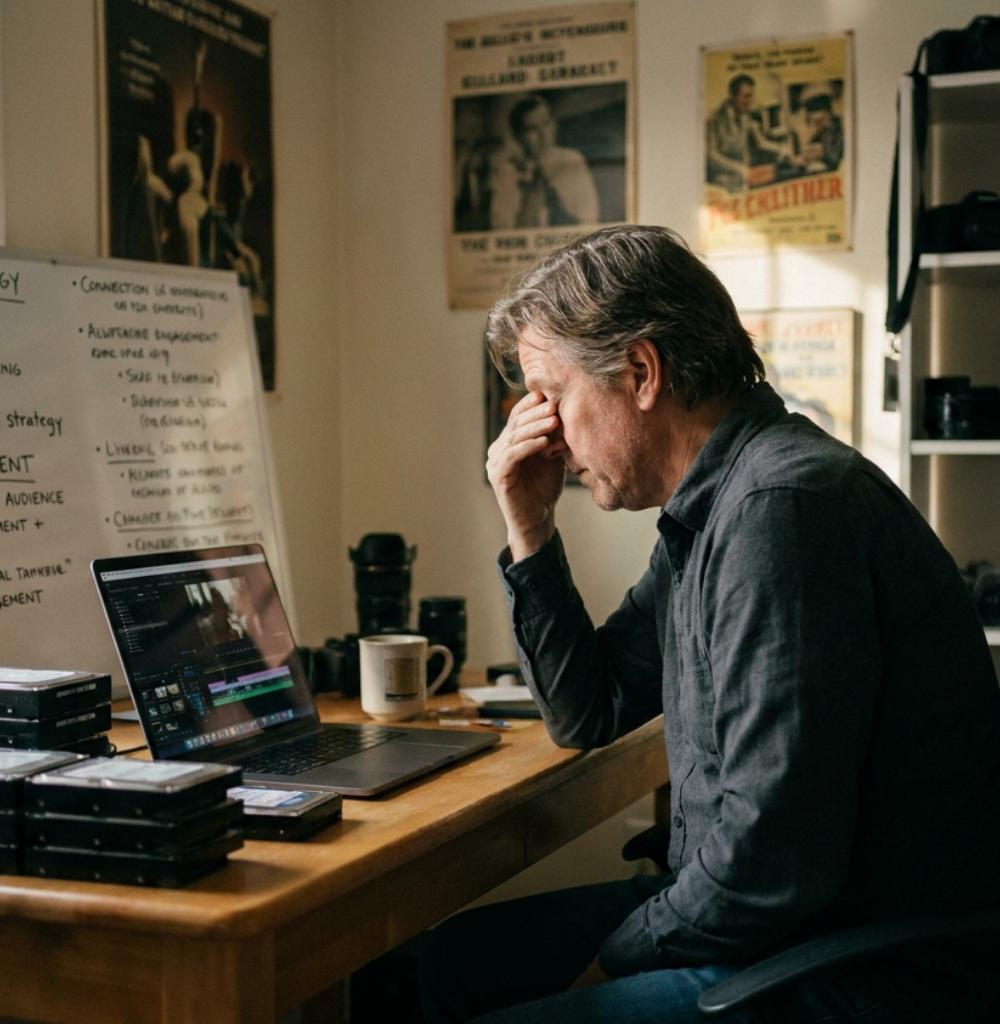
There's a move most filmmakers never make, and it has nothing to do with camera technique or script structure. It happens before the first shot and after the last festival rejection — and the filmmakers who make it consistently get their projects funded, seen, and remembered. The ones who don't keep making great work that no one watches. If you've ever poured eighteen months into a film and watched it vanish, this is the article you needed before you started.
The move is this: treating your film like a business before it's an art project. Not instead of — before. Strategy first, then poetry. Most filmmakers do it backwards, and the industry is designed to let them fail quietly.
The film doesn't fail in the edit. It fails in the plan that never existed.
What "The Move" Actually Means for Independent Filmmakers
Let's be specific, because vague advice is the enemy. The move is building what producers at the studio level call a market position — a clear, defensible answer to three questions before you spend a dollar on production: Who is this for? Where will they find it? What do they already love that this resembles?
It sounds like marketing. It is marketing. And if that word makes your stomach turn, you've already found the villain in your story. The myth that marketing is the opposite of art has killed more promising careers than bad scripts ever did.
A first-time director shooting a micro-budget horror film doesn't have a distribution problem — they have a positioning problem. The distributor, the festival programmer, the potential investor: they all need a fast, confident answer to "what is this and who wants it?" If you can't give it to them in two sentences, they move on. That's not cynicism. That's Tuesday.
Why Most Filmmakers Skip This Step (and What It Actually Costs)
The honest reason filmmakers skip the strategic move is that it feels like selling out before you've even sold in. Film school teaches craft. YouTube teaches cinematography. Almost nobody teaches market thinking, so it feels foreign — and anything foreign feels dangerous when you're already terrified the film won't be good enough.
But here's what skipping it actually costs you. Say you spend roughly $40,000 — a genuine micro-budget number — on a feature. You get into two mid-tier festivals. You submit to distributors and hear nothing back, or you get offered a deal so bad it locks your rights for seven years and pays you almost nothing. That $40,000 and two years of your life produce a film that fifty people see. Not because it wasn't good. Because nobody knew where to put it.
The common mistake isn't making the film. It's making the film in a vacuum. No audience research. No comparable titles pulled up before writing page one. No distribution strategy sketched on a napkin before the first location scout. Craft in a vacuum is just expensive journaling.
The Move, Step by Step: How to Actually Do It
This isn't theory. Here's how filmmakers who book results actually execute the move.
- Comp titles with intention. Before you write "action" on page one, name three films made in the last five years, with comparable budgets, that found an audience. Not Inception. Not The Godfather. Films a real distributor or festival programmer can picture your film sitting next to on a platform. This single exercise will reshape your script in ways that no coverage note ever will.
- Identify your audience before your locations. Who specifically is going to seek this film out? Not "everyone who loves good movies." A specific person with a specific hunger. Horror fans who follow genre blogs. Documentary audiences who already donate to environmental causes. Diaspora communities looking for stories that reflect them. Name them. Find where they already gather online and offline.
- Map distribution before you map your shoot days. Is this a festival-first film? A platform-direct film? A community screening film? Each path changes your deliverables, your budget priorities, and even your runtime. Deciding this in post is like choosing your destination after you've already been driving for six hours.
- Build the producer relationship before you need one. The filmmakers who get funded have relationships with producers they cultivated months before they had a finished script. Not pitching — listening. Asking what a producer wishes they were getting from emerging directors. That conversation is worth more than any pitch competition.
The Filmmakers Who Got This Right — and What You Can Steal From Them
Imagine a filmmaker making a documentary about urban beekeeping. On paper, that's a tough sell. But she spent three months before shooting identifying a passionate, organized audience — environmental educators, urban farming communities, and Slow Food chapters — who were already desperate for screening content. She didn't wait for a distributor to find her audience. She built the audience and then brought it to the distributor as proof of demand. That's the move.
Or picture a first-time narrative feature director who, before writing a single scene, emailed twelve festival programmers asking one question: "What kind of film are you genuinely underserved on right now?" He didn't pitch. He listened. The answers rewired his entire approach to the story he was already wanting to tell. His film premiered at a major regional festival and sold to a streamer within four months of that premiere.
Both of those are hypothetical composites — but they describe a real pattern. The filmmakers who succeed at the indie level are almost always the ones who treated intelligence-gathering as part of pre-production, not an afterthought. Explore more about building that foundation in our pre-production planning guide.
How Funding Changes When You Make This Move
Grant committees and private investors have one shared fear: the project disappears without a trace. Show them you've already thought about where the film lands and who catches it, and you've removed their biggest objection before they voice it. This is why a solid distribution strategy, even a rough one, inside your funding pitch is worth ten times more than an extra page of beautiful production stills.
The filmmakers who consistently win grants aren't always the ones with the best scripts. They're the ones who can articulate impact — who will see this, where, and what changes in them afterward. That answer comes from knowing your audience before you know your shot list. Check the resources in our funding and grants section to see how other indie filmmakers structure that argument.
The Biggest Mistake: Waiting Until It's Done
Hands down, the most expensive mistake in independent film is treating distribution and audience as a post-production problem. Festivals don't fix positioning. A good trailer doesn't fix positioning. A publicist hired two weeks before your premiere definitely doesn't fix positioning. These are amplifiers. They make a strong signal louder. They cannot create a signal that was never there.
If your film is in post right now and you haven't answered those three market questions, stop. Answer them before you picture lock. It is not too late — but it will be, soon. Your deliverables, your press materials, your submission strategy, your social presence: all of it should flow from a clear market position, not be invented around one.
And if you're in development — congratulations, you're exactly where you need to be to make this move count. Pair your script work with audience thinking. Use our screenwriting resources to strengthen the page, and use everything above to make sure someone actually sees what you put on it. Visit our film festivals guide to understand where your film fits before you submit blind.
Frequently Asked Questions
Does thinking about the market ruin creative instincts?
No — and this is the fear worth busting directly. Market thinking doesn't tell you what story to tell. It tells you how to tell your story in a way that connects with real people. The filmmakers with the strongest creative voices are almost always the ones who understand exactly what world their audience lives in. Knowing your audience sharpens your instincts; it doesn't dull them.
When exactly should I start thinking about distribution?
Before you finalize your budget. Distribution path determines your deliverables, and deliverables cost money. A film headed to international sales needs different technical specs than one going straight to a domestic streaming platform. Getting this wrong in post can cost you thousands of dollars in fixes — or cost you the deal entirely when a distributor walks over a missing deliverable.
What if I'm making a personal, experimental, or art-house film? Does this still apply?
Absolutely — maybe more so. Art-house and experimental films have a real, passionate audience. The mistake is assuming that audience will find the film by osmosis. They won't. They need to be pointed toward it through the specific galleries, microcinemas, academic institutions, and curated platforms where they already spend their attention. Niche is not small. Niche is targeted.
How do I research comparable titles without access to industry databases?
Start with what's publicly available. Festival award lists, platform recommendation algorithms, and genre-specific blogs are all free. Search "[your genre] + recent + micro-budget" on letterboxd and see what surfaces. Read programmer interviews. Watch filmmaker Q&As on YouTube from films similar to yours. You don't need a $400-a-month industry subscription to do honest market research. You need curiosity and a few hours.
Can I make this move if I'm mid-production right now?
Yes, though it's harder. Stop and answer the three market questions honestly: who is this for, where will they find it, what do they already love that this resembles? Let those answers guide your final shoot days, your pickup shots, and especially your post-production priorities. The move is always available — it just costs more the longer you wait.
The filmmakers who build lasting careers aren't always the most talented people in the room. They're the ones who refuse to let a great film die in obscurity because they were too proud or too scared to think like a producer before they thought like an artist. You made the film because something mattered to you. Now make sure it matters to someone else, too — on purpose, not by accident.
If you're ready to stop guessing and start building a real strategy around your project, FilmmakerGenius is free to start — a practical resource built for indie filmmakers who want their work to actually reach the world.