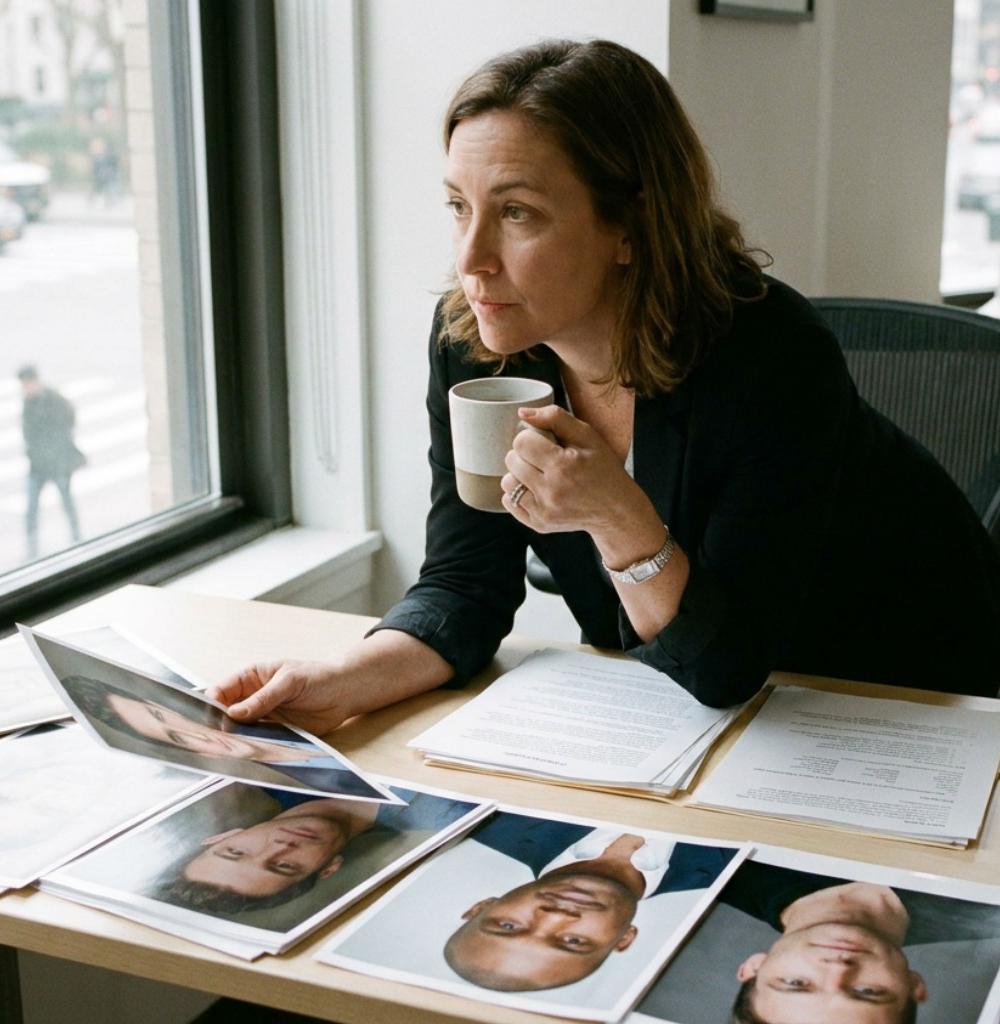
Casting directors spend less than three seconds on a headshot before deciding whether to keep scrolling. Three seconds. That's not enough time to appreciate your cheekbones or your actor training or the fact that you drove two hours to that session. Your acting headshots either stop the scroll or they don't. Everything else is irrelevant.
The maddening part? Most actors spend more time picking a frame for their apartment than they do understanding what makes a headshot actually work. They book whoever has a Groupon, show up in an outfit they "feel cute in," and then wonder why their submission rate is zero.
A headshot doesn't show who you are. It argues for who you could play — and casting needs to believe it in three seconds flat.
What a Working Acting Headshot Actually Does
Here's the answer you need before anything else: a great acting headshot is a specific casting argument compressed into a single image. It says "I am the neighbor," or "I am the detective," or "I am the exhausted mom who still has a sense of humor" — without a single word. It is not supposed to show every side of you. It is supposed to show the most bookable, most believable version of one type you play.
That's the whole job. Not beauty. Not range. Not personality soup. One clear, honest, castable read — repeated across two or three looks in your portfolio so that a casting director can slot you into their breakdown without having to imagine anything.
How Much Should You Pay for Acting Headshots?
Rates vary wildly depending on your market, but here's a rough map: in a secondary market like Atlanta, Austin, or Chicago, a reputable headshot photographer typically runs $200–$500 for a session that includes two or three looks and a reasonable number of final selects. In Los Angeles or New York, you should budget $400–$900, sometimes more, for a photographer whose work you see regularly on Actors Access or Casting Networks.
The dangerous middle ground is the $150 session that delivers 300 raw files. You're not a photographer. More images don't help you — they just mean more decisions you're not qualified to make. A photographer who delivers 10 to 20 carefully retouched selects and actually talks to you about your type before you step in front of the camera is worth twice the price of someone who just clicks a shutter for an hour.
Do not use Groupon. Do not use a friend with a "really good camera." Headshots are the one place where a working actor cannot afford to cut corners, because bad ones don't just fail to help — they actively signal that you don't take yourself seriously.
What to Wear — and Why Most Actors Get This Wrong
The biggest headshot mistake, by a distance, is wearing something "interesting" when you should be wearing something that disappears. Casting is looking at your face and your energy. A loud pattern, a statement necklace, a bold graphic tee — all of those things pull the eye away from exactly where it needs to be.
Wear solid, mid-tone colors that complement your skin tone without matching it. Navy, burgundy, forest green, slate gray — these work across the board. Avoid pure white (it blows out against almost any background) and pure black at the neckline (it creates a floating-head effect). Bring three to four options and let the photographer weigh in.
One practical note: bring a lint roller, a small steamer or wrinkle spray, and anything that makes you feel physically comfortable. Tension lives in the jaw and the shoulders. If you spend the first 20 minutes of a session worrying about a wrinkle in your shirt, that tension ends up in your eyes — and casting can read that from a thumbnail.
Finding a Headshot Photographer Who Actually Knows the Industry
The test is simple: look at their portfolio and ask yourself whether you recognize the work. Not whether the photos are pretty — whether you've seen those faces on Actors Access submissions, on the walls of casting offices, in the waiting rooms of auditions you've sat in. A great headshot photographer doesn't just understand light; they understand the submission ecosystem and they shoot specifically for it.
Ask them directly: "Who do you primarily shoot?" If the answer is "mostly corporate headshots and some actors," keep looking. You want someone whose whole practice is built around this niche. They will know what resolution Actors Access requires, how tight the crop should be, and whether your type reads as "lead" or "supporting" — and they'll tell you the truth about it.
Before you book, do the homework. Search their name on Actors Access or browse the actor community on Reddit's r/acting or local Facebook groups for your market. Working actors talk. If a photographer consistently produces headshots that book, that reputation spreads fast.
Theatrical vs. Commercial Headshots: You Probably Need Both
Theatrical headshots lean serious. More intensity in the eyes, more stillness in the expression, clothing that suggests a character. These are for dramatic TV, film, and stage submissions where casting wants to see depth.
Commercial headshots are warmer, more open — a genuine smile or a hint of one, approachable energy, the sense that you would make someone buy a car or feel good about a brand. Commercial casting directors are looking for likability at speed.
Most working actors need at least one strong shot in each category. When you upload to Actors Access, you can designate your primary image, but having the right image for the right breakdown category is how you stop being ignored in a search. Think of it like having a work suit and a dinner jacket — same person, different argument.
How Often Do You Need New Acting Headshots?
The honest answer: whenever you look substantially different from your current photos, or whenever you're going out on submissions regularly and not getting called in. Those are the two triggers. Not a calendar rule, not every year automatically.
If you've gained or lost significant weight, changed your hair dramatically, aged noticeably — get new ones. Casting directors feel genuinely deceived when the person who walks into the room looks nothing like the submission photo. That's not a minor inconvenience; it burns a relationship.
If your photos are technically fine but you're simply not booking auditions, consider whether the images are selling the right type. Sometimes new headshots aren't the fix — sometimes you need to reassess your type and your approach. That's a deeper conversation, and a good place to start is studying your own audition strategy and casting targets before spending money on a new session.
The Self-Tape Connection Most Actors Miss
Here's something almost nobody talks about: your headshot and your self-tape need to argue the same case. If your headshot says "young professional, sharp, trustworthy" and your self-tape setup looks like a dorm room with a bedsheet background and blown-out windows, you've just contradicted your own brand. Casting's first impression (the headshot) promised something your tape didn't deliver.
Getting your self-tape presentation dialed in is the other half of the equation — and it's more achievable than most actors realize. A decent key light, a clean neutral background, and a camera at eye level can transform your submission. If you want to build that setup step by step without guessing, HowToSelfTape is free to start and walks you through everything from lighting to framing specifically for actor submissions. No fluff, no gear-worship — just what actually works for the submission ecosystem your headshot is already trying to crack.
Your headshots open the door. Your self-tape keeps it open. Get both right and you're genuinely dangerous in a submission pool.
Keep reading: What to Wear to a Headshot: The Actor's Wardrobe Guide, How to Get a Talent Agent: An Actor's Playbook, and How to Book a Commercial: A Working Actor's Guide.
Frequently Asked Questions About Acting Headshots
Can I use a smartphone for acting headshots?
Technically, modern smartphones can produce sharp images — but sharpness isn't the issue. A professional headshot photographer brings knowledge of light, posing, expression coaching, and industry-specific framing that a phone session with a friend simply cannot replicate. For a submission tool this critical, the professional session is worth every dollar.
Should my headshot have a background or be outdoors?
Both work, but the background should never compete with your face. Clean, slightly blurred outdoor backgrounds — a wall, a doorway, some soft foliage — can add warmth. Studio backgrounds work for a crisp, commercial look. The rule is simple: if you glance at the photo and your eye goes anywhere other than straight to the actor's eyes, the background is wrong.
Do I need to smile in my headshot?
For commercial submissions, a genuine warm smile is nearly essential. For theatrical, a more neutral, present, slightly intense expression tends to read better. The word "genuine" is doing a lot of work in that first sentence — a forced smile reads as forced, and casting can clock it instantly. Work with your photographer to find an expression that feels natural, not performed.
How many headshot looks do I need?
Two to three is the practical sweet spot for most working actors: one strong theatrical, one strong commercial, and possibly a third that targets a specific type or age range you're actively pursuing. More than four looks tends to dilute focus. Lead with your absolute strongest image everywhere — Actors Access, your agent submissions, your website.
What resolution and format does Actors Access require for headshots?
Platforms update their specs periodically, so always verify the current requirements directly on the Actors Access website before uploading. As a general rule, a high-resolution JPEG at 300 dpi and at least 1,800 pixels on the short side will cover most submission platforms — but don't guess. Wrong specs mean a compressed, muddy photo undoing all the work you paid for.
The actors who book consistently aren't always the most talented people in the room. They're often the ones who treated every piece of their submission package — headshots, reels, self-tapes — as seriously as the actual performance. The work starts before the camera ever rolls. Make sure the door is open before you try to walk through it.