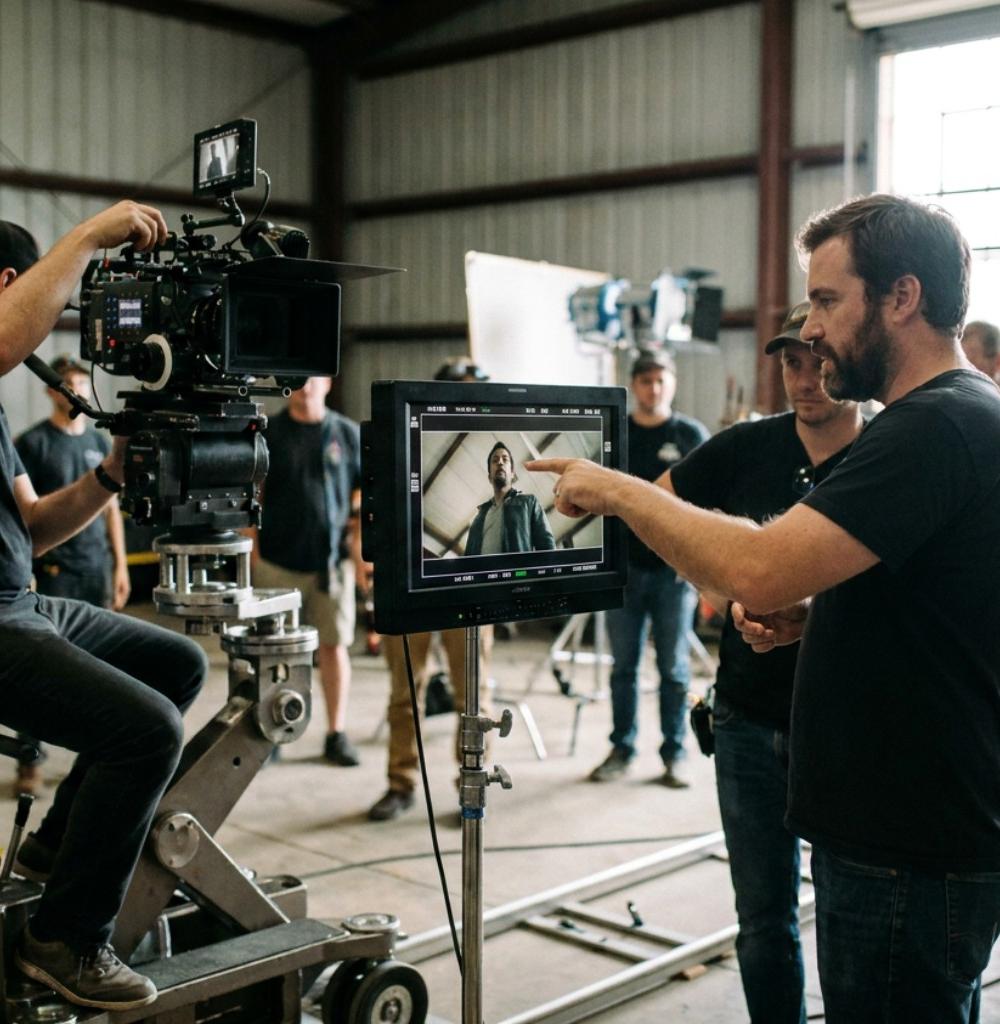
A first-time director once locked a perfectly staged, beautifully lit scene — and it was completely inert. The performances were solid. The dialogue crackled. But every shot was eye-level, every cut neutral, every angle the same safe choice made over and over. The audience sat politely. Nobody felt a thing. That director learned what every cinematographer already knows: camera angles types are not technical options. They are emotional levers. Pull the wrong one and you drain the tension out of a room. Pull the right one and the audience leans forward without knowing why.
Camera angle types refer to the vertical position and orientation of the camera relative to the subject — high, low, canted, or level — and each one sends a psychological signal the viewer receives before a single word of dialogue is spoken. Master these seven angles and you hold the grammar of visual storytelling in your hands.
Why Camera Angles Types Are the Most Underused Tool in Low-Budget Filmmaking
Lenses cost money. Lighting packages cost money. Actors cost money. But lowering your camera six inches to the ground costs you exactly nothing — and it can transform a villain's entrance from forgettable to genuinely threatening. That's the dirty secret of indie cinema: camera placement is free. It's also the thing most emerging directors sacrifice first when they're rushing through a twelve-hour shooting day.
The directors who separate themselves — the ones getting into Sundance on a $30,000 budget — are not the ones with the best gear. They're the ones who spent three hours in pre-production drawing shot lists that exploit every possible angle before a single light stand went up. Angle choices made in prep cost you nothing. Angle choices discovered on set cost you time you don't have.
The camera is not a recording device. It is a point of view — and every angle you choose tells the audience how to feel before anyone opens their mouth.
The 7 Core Camera Angle Types (And What Each One Actually Does)
1. Eye-Level Angle
The camera sits at roughly the subject's eye height. This is the neutral handshake — it creates equality, intimacy, and a sense of everyday reality. It's the workhorse of dialogue scenes. The risk: overuse it and your film feels like recorded theater. It should be your default only when you consciously want the audience to feel like a peer of the character, not a witness to them.
2. High Angle
The camera looks down on the subject. Instantly, the character reads as smaller, weaker, overwhelmed. Used on a child speaking to a parent, this angle doesn't need a line of dialogue to communicate powerlessness. Used on a protagonist standing in a vast empty landscape, it communicates existential isolation in a single frame. This is one of the most powerful camera angles types for establishing vulnerability without sentimentality.
3. Low Angle
The camera looks up. The subject looms. They feel dominant, threatening, or larger-than-life — sometimes heroic, sometimes monstrous, depending on the context. Orson Welles built an entire visual vocabulary around the low angle. On a micro-budget shoot, a low angle shot costs you nothing but a willingness to put your camera operator on the ground.
4. Dutch Angle (Canted Angle)
The camera is deliberately tilted on its horizontal axis. The horizon line goes diagonal. Disorientation, moral corruption, psychological unease — this is the angle of the thriller and the horror film. Use it sparingly. The mistake most first-time directors make is reaching for the Dutch angle every time they want something to feel "edgy." When overused, it stops reading as psychological and starts reading as stylistic sloppiness. Save it for the moment your protagonist realizes the world is no longer what they thought it was.
5. Bird's Eye Angle
Directly overhead. The subject is flattened, abstracted, reduced to shape and pattern. This is the godlike perspective — the audience sees everything the character cannot. It can feel clinical, omniscient, or deeply lonely. A character lying on a bathroom floor, seen from directly above, hits harder than almost any other composition you could choose for that beat. Drones have made this angle accessible to indie filmmakers at a price point that would have been unimaginable ten years ago.
6. Worm's Eye Angle
The extreme version of the low angle — the camera is essentially at floor level looking straight up. Buildings feel like they might collapse inward. People become giants. Urban environments turn into concrete canyons. This angle is deliberately unnatural, which makes it ideal for moments of surrealism, nightmare sequences, or to signal that a character's perception of reality has been distorted.
7. Over-the-Shoulder Angle
Technically a framing choice as much as an angle, but it carries its own emotional logic: the audience is literally positioned behind one character looking at another. It creates identification and presence. In a confrontation scene, which shoulder you put the camera over determines who the audience is rooting for, often subconsciously. Reverse your OTS shots with intention, not just for coverage.
The Most Common Camera Angle Mistakes on Indie Sets
The number one error isn't using the wrong angle — it's using every angle at the same focal length and distance, so that even varied angles start to feel monotonous. A low angle loses half its power if you're using the same 35mm lens at the same distance you used for the eye-level shot. Angle, lens length, and distance work together. Change one without considering the others and you're leaving power on the table.
The second common mistake is unmotivated variety. Some directors, after learning about Dutch angles and bird's eye shots, suddenly want to deploy them all in a single scene to prove they know the vocabulary. Audiences don't feel "wow, great cinematography." They feel confused and exhausted. Every angle choice must serve the story's emotional truth at that specific moment.
Learn more about building a coherent visual plan in our guide to pre-production strategy at OnSet Report, and explore how directing on set connects shot choices to performance.
How to Use Camera Angle Types in Your Shot List
Before you walk onto any set, every scene should have a clear emotional intention — one sentence: "In this scene, the audience must feel that Marcus is losing control." From that sentence, your angle choices write themselves. High angles when he's being pressured. A slow creep to a low angle as he begins to snap back. A Dutch angle at the moment he crosses the line. That's not showing off. That's visual storytelling doing the work that dialogue alone can't.
A useful habit borrowed from experienced DPs: annotate your shot list not just with angle names but with the emotion you want the viewer to feel. "Low angle — audience should fear Marcus before he speaks." That annotation forces you to verify your angle is actually earning its place.
Our cinematography resources at OnSet Report go deeper on building shot lists that actually survive contact with a production day.
What Experienced DPs Know That Directors Often Miss
Camera height is only half the equation. The other half is the subject's eye line and what they're looking at. A low angle on an actor who's looking down at their hands reads completely differently from a low angle on an actor staring directly into the lens. The angle gives the frame its power structure; the eye line tells the audience where that power is directed. The two work together, and ignoring the relationship between them is one of those subtle craft gaps that separates a film that feels "almost there" from one that feels fully realized.
If you're in the middle of developing your visual language and want a structured way to think through how angles connect to story, FilmmakerGenius at filmmakergenius.com is a genuinely useful starting point — free to explore, built specifically for independent directors who want to work smarter in pre-production.
Keep reading: Three-Point Lighting: The Setup Behind Every Good Shot, Natural Lighting in Film: A Practical Shooting Guide, and Shooting Schedule: How Pros Build One That Won't Collapse.
Frequently Asked Questions About Camera Angles Types
What is the most important camera angle type for beginners to master first?
Start with the eye-level shot — not because it's the most dramatic, but because understanding neutral gives you a baseline. Every other angle only communicates meaning in contrast to that neutral. Once you feel the difference when you tilt the camera even five degrees, you'll start to see angle choices everywhere you look.
How do camera angle types affect the audience emotionally?
Angles manipulate perceived power and proximity. High angles shrink characters and create sympathy or pity. Low angles expand them, triggering awe or fear. A Dutch angle destabilizes the world. These reactions are largely involuntary — the audience processes them before conscious thought kicks in, which is exactly why they're so effective.
When should you use a Dutch angle versus a high angle?
Use a Dutch angle when the world itself feels wrong — psychological corruption, unreliable reality, moral chaos. Use a high angle when the character's position within a stable world feels diminished or powerless. The Dutch angle is about disorder; the high angle is about hierarchy. They look similar on paper but communicate very different things.
Can you mix multiple camera angle types in a single scene?
Yes, but with discipline. The most effective scene-level angle design usually has one dominant angle grammar and one deliberate break from it. The break is where the emotional peak lives. If every shot is a different angle, none of them land. Consistency creates expectation; the break from consistency creates feeling.
Do camera angle types matter for documentary filmmaking too?
Absolutely — and documentarians often underestimate this. A low angle on an interview subject signals authority and gravitas. A high angle can feel condescending, whether you intend it or not. Some documentary directors shoot every interview at strict eye level as an ethical statement about equality between filmmaker and subject. That's an angle choice with a philosophy behind it.
The scene that just sits there and the scene that makes an audience catch their breath are often separated by a single decision made before the shoot began — where to put the camera and which direction to point it. That's the whole game. Study these camera angles types until they stop being a checklist and start being instinct. Your story is waiting for a filmmaker who knows the difference between a frame that records and a frame that means something. Go make that film.
Explore more craft fundamentals in our directing on set section and deepen your pre-production thinking at OnSet Report's pre-production hub.