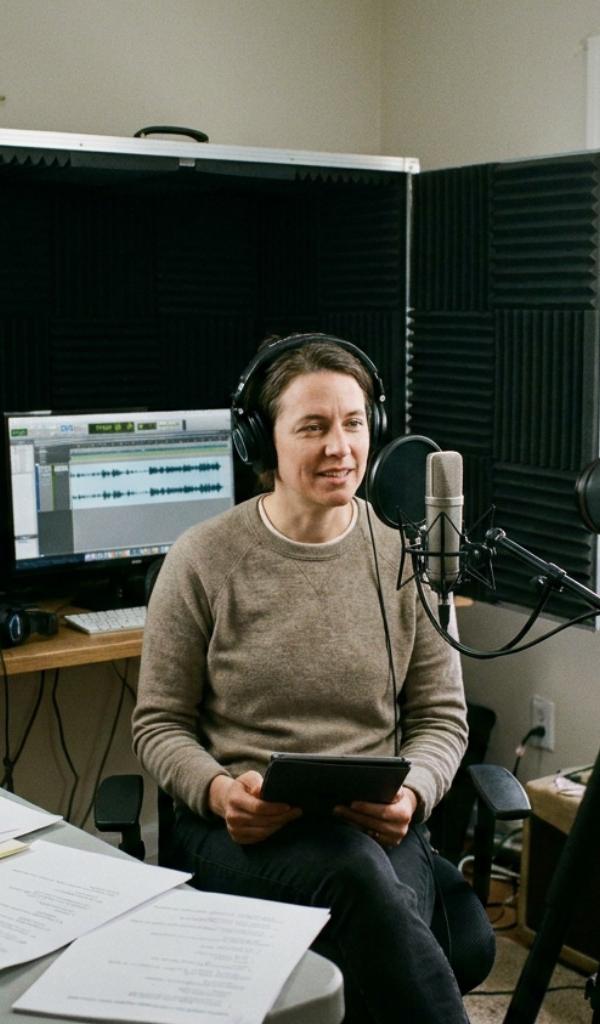

Every actor dreams about the same two jobs: the national commercial that pays residuals for years, and the animated series where you get to build a beloved character. Those dreams are fine — chase them. But here's a question worth sitting with: when's the last time you heard an actor say, with genuine excitement, "I can't wait to narrate a corporate compliance module"? Never. Nobody dreams about it. And that — that total absence of glamour, that fact that everybody's chasing the flashy work and almost nobody's chasing this — is exactly why e-learning and corporate narration is one of the best-kept secrets in voice over. It's unglamorous, it's relentless, and it quietly pays the rent while the flashier work is still landing somewhere off in the distance. The category that no one brags about is the one that keeps working actors solvent.
What This World Actually Contains
Let's be specific about what this world actually contains, because "corporate narration" sounds like one boring thing and it's really a dozen. Training and e-learning modules — the courses employees click through for onboarding, safety, and certification. Explainer videos — the animated "here's how our product works" pieces that live on every company's homepage. Internal communications — CEO messages, culture videos, all-hands narration. Product walkthroughs and demos. And the technical and specialized niches: medical narration, financial and insurance explainers, software tutorials, industrial and manufacturing training. Every company on earth produces this content, constantly, forever. It never trends, it never goes viral, and it never stops.
It Values Trust, Not Flash
What this category values is not flash — it's trust. Clarity, warmth, an even and intelligent tone, and the genuinely rare ability to make dry copy listenable. This is the whole skill, and it's harder than it sounds. Anyone can read a sentence about workplace hazard protocols. Almost nobody can read it in a way that makes a distracted employee actually want to keep listening instead of tabbing away. If you can take a paragraph about safety procedures or expense-report policy and deliver it so a real human being stays engaged, comprehends it, and doesn't feel talked down to — you are employable indefinitely, in any economy, forever. That's not hyperbole. Clarity that holds attention is a scarce, permanent, recession-proof skill.
The Performance: Guiding, Not Selling
The performance itself is subtle, and getting the frame right is everything. You are not selling — drop the commercial energy entirely. You're guiding. The read has to sound like a knowledgeable, friendly person who honestly cares that you understand the material — a great teacher, a patient colleague walking you through it, not a spokesperson and not a robot. And within that, pace is the master control. This is where beginners fail: rush it, and comprehension collapses — the listener can't absorb information delivered at commercial speed. Drag it, and they tune out and check their phone. You have to find the pace of genuine understanding, often slower than feels natural, with room around the key points so the information can actually land. You're pacing for a brain that's trying to learn, not for a scroll that's trying to be interrupted. It's still acting — the intention is simply "help you understand" instead of "make you buy."
Pronunciation Precision Is the Whole Job
Then there's pronunciation precision, and in the technical corners of this category it's not optional — it's the whole job. Medical, financial, pharmaceutical, legal, and technical narration are stuffed with terms most people can't pronounce on sight, and here's the hard rule: a single mispronounced drug name or technical term doesn't just look sloppy — it costs you the client, permanently. So the pros do the unglamorous work. They research pronunciations before recording, they build glossaries, they ask the client for a pronunciation guide, they look up the terms they don't know instead of guessing. That diligence is invisible when you do it and catastrophic when you skip it, and it's a big part of why reliable technical narrators get paid so well: most people won't do the homework.
Why the Business Is So Steady
The reason the business is so steady comes down to two things. One: companies produce this content endlessly — new products, new policies, new training, new compliance requirements every single quarter, in every industry, worldwide. The demand literally cannot run dry. Two: what those companies desperately want is a narrator who hits spec, hits deadline, and does it without drama. Reliability is the entire game. A corporate client with a video budget and a Friday deadline does not want a temperamental artist; they want the person who delivers clean, correct, on-time files and is easy to email. Become that person and you don't get one job — you get every job that client produces from now on, because switching narrators is a hassle they'd rather avoid. This is a rehire business at its purest — and hitting spec every time comes down to the same clean home-recording discipline you already use for self-tapes.
Volume and Repeat Business, Not Lottery Tickets
Rates are typically per project or per finished minute — modest on any single job compared to a national commercial. But that framing misses the point. The power here is volume and repeat business. A steady stable of corporate clients feeding you regular projects builds a dependable monthly income floor that doesn't depend on booking a lottery ticket. It's the difference between "I might get a huge check if I book the Super Bowl spot" and "I know roughly what I'm making this month because three companies send me work every few weeks." The first is a gamble. The second is a business.
The Base of the Full Stack Pyramid
And that's exactly why, for a Full Stack actor, this is the base of the pyramid. It's the dependable, low-glamour work that funds the pursuit of the high-glamour work. The residual-paying commercial and the dream animation gig can take years to land, and years are expensive. E-learning and corporate narration pays for those years. It buys you the runway to keep auditioning for the flashy stuff without going broke or quitting. So do not be too cool for it — that pride is a luxury working actors can't afford. The performers who last in this business, decade after decade, are almost never the ones who only chased glamour. They're the ones who built a floor first, and then chased the ceiling from a position of stability. Build the floor. It's the least glamorous advice in voice acting and the most important.
This work rewards clean, on-spec files delivered without drama — which starts with a room and a workflow you can trust. HowToSelfTape is free to start and covers the home-recording setup that makes your narration hit spec and your self-tapes sound professional.