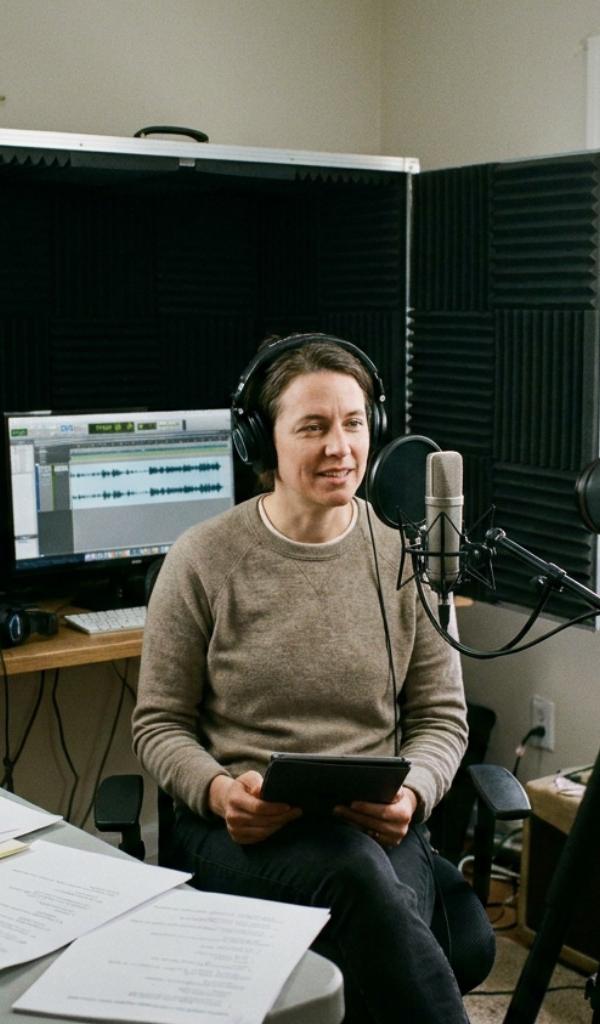

If there's a single skill that separates the voice actors who build careers from the ones who book one job and vanish, it isn't talent. It's this: the ability to take direction fast and without ego. Talent gets you the audition — it's the price of admission, the thing that puts you in the room in the first place. But once you're in the room, talent is table stakes; everyone in the running has it. What actually decides whether you get rehired is adjustability — how quickly and cheerfully you can change what you're doing when someone asks. Talent gets you the audition. Adjustability gets you the career. Nobody tells beginners this, so they spend all their energy on the wrong half.
What a Real Session Actually Sounds Like
Here's the reality of an actual session, because it's nothing like the fantasy of nailing a perfect read in one take. Directors give notes in a constant, rapid loop. You do a take, and immediately: "Warmer." You adjust, another take: "More real." Again: "Less announcer." Again: "Smile more." Again: "Okay, take out the smile." It's fast, it's relentless, and it's normal — that back-and-forth is the process, not a sign you're doing badly. And then, eventually, every voice actor hears some version of the infamous abstract note: "Can you make it sound more… purple?" Or bluer. Or rounder. Or "give me more Tuesday." There is no dictionary definition of a purple read. And here's the thing you have to internalize: that's not the point. The director isn't testing your knowledge of color theory. They have a feeling in their head they can't quite name, and the note is them reaching for it. The entire question — the only question that matters in that moment — is whether you can offer three different colors immediately and let them pick, instead of freezing, arguing, or getting precious about the read you were proud of.
The Three Failure Modes That Get You Replaced
Because those three failure modes are exactly how people get replaced. Freezing — going blank, asking "what do you mean by purple?" in a helpless way — kills the momentum and reads as "this person can't take a note." Arguing — explaining why your original choice was actually the right one — is career suicide; nobody hired you to defend your first instinct, they hired you to serve their project. And getting precious — visibly deflating because they didn't love your take — makes you exhausting to work with. All three telegraph the same thing: this actor's ego is in the room, and it's going to cost us time.
Treat Every Note as a Fun Problem
The actors who thrive do the opposite, and they do it with a specific mindset: they treat every note as a fun problem, not a criticism. A director says "purple," and instead of stalling, you play. You instantly try it richer. Then slower. Then more playful. Then more mysterious. You cheerfully throw options at the wall — "here's one, here's another, want it even further?" — until something clicks and the director lights up. You're not guessing anxiously; you're offering generously. And the effect on the session is enormous: it stays loose, fast, and productive, the director feels like they have a collaborator instead of a problem, and the client walks away remembering you as easy and fast. Burn that phrase into your brain, because in this business, easy and fast is worth more than "brilliant but difficult" almost every time. A director will rehire a very-good actor who makes the session effortless over a great actor who makes it a fight — every single time, without hesitation — because their day, their budget, and their sanity depend on it.
Translate Vague Notes Into Concrete Choices
There's a practical craft skill hiding inside all this, too, which is learning to translate vague notes into concrete choices in your own head. When a director says something abstract, you privately convert it into something actionable. "Warmer" usually means slower, closer to the mic, more breath, less push. "More real" means drop the performance polish, add imperfection, talk like you're not being recorded. "Purple" might mean richer and more sensual, or more theatrical, or more mysterious — so you try each. The pro isn't waiting to be told exactly what to do; they're rapidly hypothesizing what the feeling behind the word might be and giving the director options to choose from. That's a rehearsable skill, and every rep makes you faster at it.
The Other Gate: The Willingness to Sound Stupid
And this connects to the other gate nobody warns you about: the willingness to sound stupid. Voice work will constantly ask you to make sounds your ego hates — silly cartoon voices, weird accents, a death scream, twelve increasingly ridiculous reads of the same line, all alone in a padded closet talking to no one. If some part of you is too cool for that, too self-conscious, too attached to seeming impressive — voice acting isn't going to work for you, because the whole job lives on the far side of that embarrassment. But here's the reframe that should give you total confidence: that's the exact same vulnerability self-taping already demands of you. Every time you self-tape, you perform full-out, big emotions and all, to an empty room and a phone. You've already been doing the thing that stops most people cold — committing completely with no audience, no scene partner, no dignity-preserving crowd to hide in. If you can look foolish alone in a room, you have already passed the test that filters out most of your competition. You just have to recognize that you've passed it.
Direction Is the Job
So here's the whole thing distilled: drop the ego, keep the options coming, and stay light on your feet. Direction is not an attack on your choice. It's not a verdict on your talent. It's not a sign you failed the first take. Direction is the job — the collaborative, fast, ego-free problem-solving that a session is actually made of. The actors who understand that get to keep doing it for decades. The ones who take it personally get replaced by someone who thought "purple" sounded like fun.
The fastest way to build ego-free adjustability is reps in front of your own camera. HowToSelfTape is free to start and helps you drill the full-out, no-audience commitment that makes taking direction — on mic or on camera — second nature.