Ask a beginner what makes a voice recording sound amateur and they'll say the microphone. They're wrong, and the mistake costs them jobs. The number-one amateur tell in voice over isn't a cheap mic — it's reverb. It's the sound of the room. A casting director or an author can hear a "kitchen" or a "spare bedroom" in the first two seconds of an audition, and the moment they hear it, they're done. They don't finish the read, they don't consider the performance, they just move to the next file. Here's the genuinely liberating part, though: fixing reverb costs almost nothing, because in this game room acoustics beat gear every single time. The most important upgrade you can make to your sound isn't something you buy. It's something you build out of stuff you already own.
Your Real Enemy Is Reflection
To fix it, you have to understand your actual enemy, which is reflection. When you speak, sound radiates out in every direction, hits the hard flat surfaces of your room — walls, windows, floors, ceilings, that nice big desk — and bounces straight back into the microphone a few milliseconds after your direct voice. Your mic captures both: the clean sound coming straight from your mouth and the smeared, delayed copies ricocheting off every surface. Those reflections pile up into that hollow, ringing, "recorded-in-a-room" quality — the exact thing that screams "home hobbyist." The fix is simple in principle: replace hard, reflective surfaces near you with soft, irregular ones that absorb sound instead of bouncing it. And critically — you do not need acoustic foam panels, bass traps, or a professional booth to do it. Those are upgrades, not requirements, and plenty of working narrators never buy a single foam panel.
The Best Free Booth: A Closet Full of Clothes
The single best free booth in most homes is a closet full of hanging clothes, and it's not a compromise — it's genuinely excellent. Think about why: the clothing is soft, dense fabric absorbing reflections from every angle at once, and the closet itself is small and packed, so there's very little open air for sound to bounce around in before it dies. You step in, face the clothes (not the door), get your mic close, and you're recording in one of the deadest, most professional-sounding spaces in your entire home — for free. Walk-in closets are ideal, but even a standard reach-in closet, recorded standing in the doorway facing the packed rail, is a massive step up from any open room.
No Closet? Build a Blanket Fort
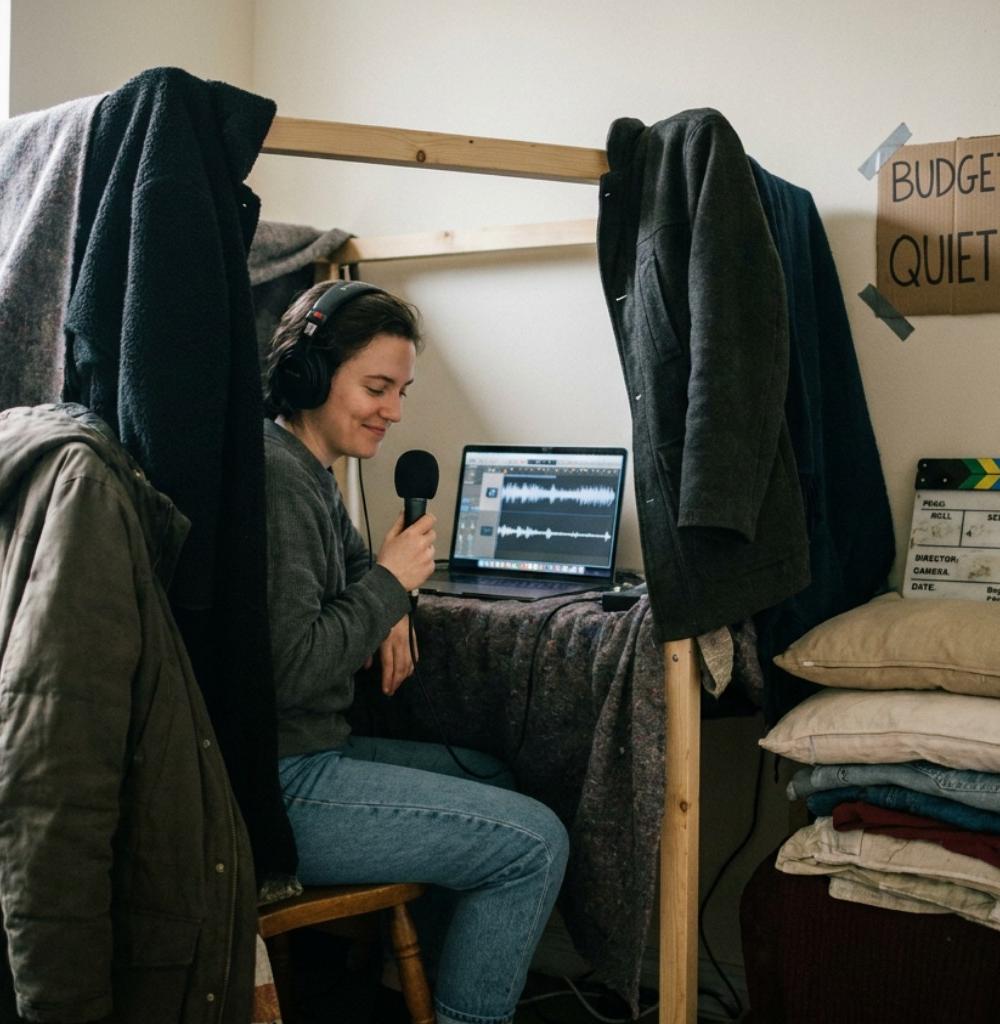
No usable closet? Build a blanket fort — and I mean that literally, not as a joke. Drape heavy blankets or moving blankets around and over yourself and your mic; hang duvets or comforters in a corner to deaden the two walls behind and beside you; throw a thick blanket over your head and the mic if you have to. Moving blankets (the quilted kind movers use) are the budget hero here because they're dense and cheap. The goal, whatever the method, is a sound that's dead and close — like the room has been wrapped tightly around your voice and there's simply nowhere for an echo to form. If you're treating an open corner instead of a closet, hit the surfaces closest to you and the mic first — the wall behind you, the wall beside you — and don't forget the sneaky reflectors: a bare window (cover it), a hard floor (throw a rug down), a hard desk (drape it). Softening the surfaces nearest the mic matters far more than the far side of the room.
The Clap Test: How to Know It's Working
And here's how you know it's working, with zero equipment: the clap test. Stand in your space and clap once, sharply, and just listen to what happens to the sound. If you hear any ring, any tail, any little "aaah" of echo trailing off after the clap — your room is still live, and it'll be live in your recording too. Keep adding soft material — more blankets, more clothes, cover another surface — and clap again. When the clap comes back short and flat and dead, like it hit a pillow and stopped, that's it. That flatness is what "professional" sounds like. You're not chasing a fancy tone; you're chasing the absence of room. A dead clap means a clean voice.
Two More Free Wins: Noise Floor and Timing
Once the reflections are handled, there are two more free wins that separate the pros from the almost-there. First, control your noise floor — the layer of background hiss and hum that's present even when you're silent. Every home is full of quiet enemies: the refrigerator compressor, the AC or furnace, a buzzing phone charger, a humming computer fan, fluorescent lights, the dishwasher two rooms over. Individually you stop hearing them; collectively your mic hears all of them, and a high noise floor will get an audiobook file rejected outright by ACX's spec. So kill them: turn off the fridge while you record (just remember to turn it back on), shut down the HVAC, unplug the buzzing charger, move away from computer fans, record on a laptop on battery if the tower is loud. Second, record when the world is quiet — early morning, late night, whenever the street traffic, the neighbors, the lawnmowers, and the kids are at their lowest. And watch the meter when you're silent: that reading is your noise floor, and lower is always better.
Consistency of Environment
Underneath both of these is a principle worth naming: consistency of environment matters as much as consistency of mic distance. A pro isn't just consistent in how they sit at the mic — they're consistent in when and where they record, so today's take matches last week's take and pickups drop in seamlessly. A quiet, controlled, repeatable space is itself a professional skill.
Kill the Room, Leapfrog Everyone
Master this one thing — killing the room — and you leapfrog the overwhelming majority of people trying to break in, because it's the exact thing they're getting wrong. Say it back to yourself until it's reflex: a treated closet with a $90 mic beats an untreated living room with a $900 mic, every time. Reverb is the tell. It's the single sound that gets you passed over before you've said a word worth hearing. Kill it — with clothes, blankets, a clap test, and a quiet hour — and suddenly you don't sound like an actor recording in an apartment. You sound like you belong in the booth. Which, now, you do. It's the same room discipline that already makes your self-tapes look professional — pointed at your ears instead of the camera.
Treat the room once and it works for your voice and your camera both. HowToSelfTape is free to start and walks you through the cheap, no-foam acoustic fixes that make any corner sound — and look — like you belong there.