
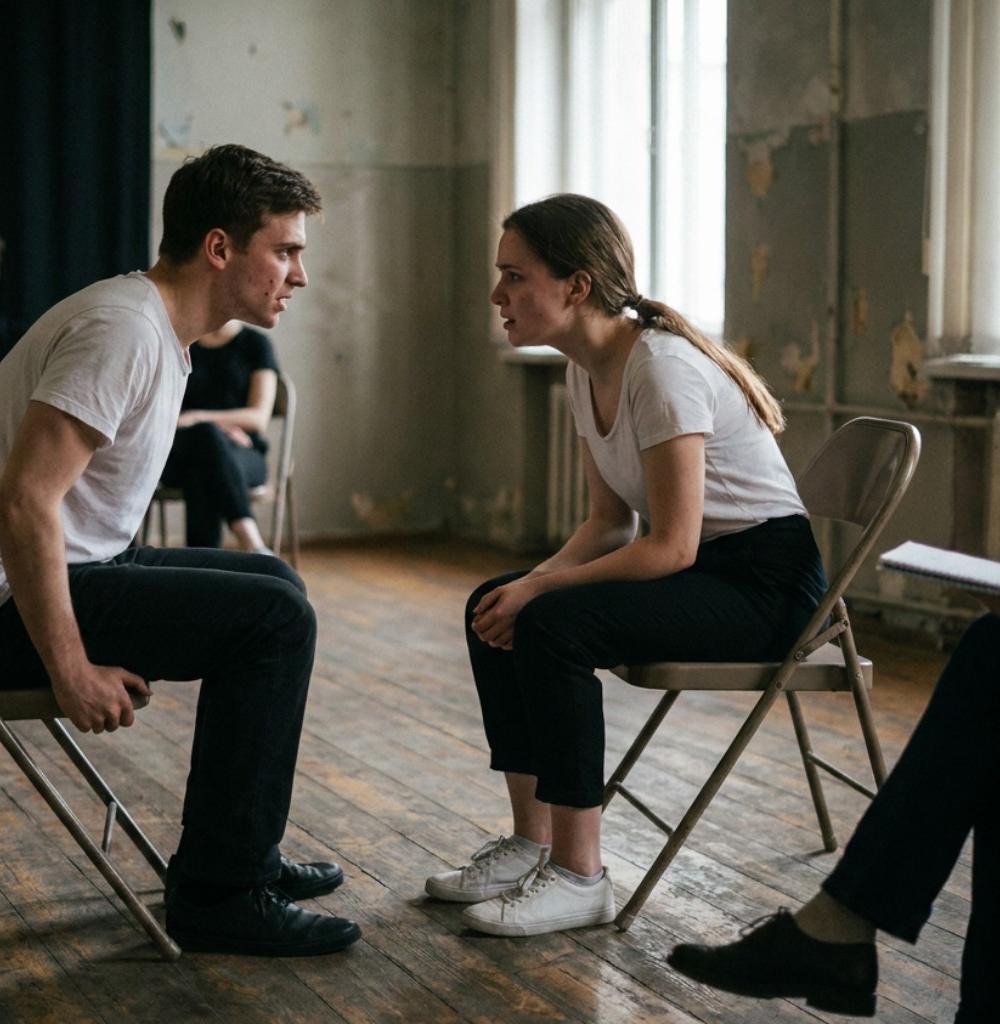
The first time a student truly does the Meisner technique, they usually cry — and not because the scene is sad. They cry because, maybe for the first time in their career, they stopped performing and started living. That's the whole game. That's the entire point. Sanford Meisner spent decades distilling acting down to one sentence, and it's the most ruthlessly simple instruction in the craft: live truthfully under imaginary circumstances.
The actor who is truly listening has already done the hardest thing anyone on a set will do all day.
What the Meisner Technique Actually Is
Sanford Meisner was a founding member of the Group Theatre in New York in the 1930s, trained alongside Lee Strasberg and Stella Adler, and then spent the rest of his life disagreeing with both of them. Where Strasberg pulled actors inward — mining personal memory and emotional recall — Meisner pushed actors outward, toward their scene partner. His argument was brutal and correct: you cannot fake a real reaction. You can only get one from something that genuinely happens to you, in the room, right now.
The technique rests on two foundational pillars. First, the Repetition Exercise — two actors facing each other, saying back and forth exactly what they observe the other person doing, feeling, or being. "You're nervous." "I'm nervous." "You're nervous." It sounds absurd. It is absurd. And it rewires your entire nervous system as an actor, because you have to keep your attention locked on another human being instead of on your own internal monologue. Second, the concept of the given circumstances — the imaginary life of the character that the actor must prepare so thoroughly that the fiction feels as urgent as reality.
Together, those two pillars build one skill: genuine, unmanufactured response. Not what you planned to feel. What you actually feel because of what your partner just did.
How the Meisner Technique Differs From Method Acting
People confuse these two constantly, and the confusion costs actors real work. Method acting — as practiced through Strasberg's Actors Studio — leans heavily on emotional memory and sense memory. You access the emotion by re-experiencing something painful from your own life. Meisner thought this was, to put it diplomatically, a detour. His objection: why drag your own trauma on stage when the scene gives you everything you need, if you're truly paying attention to your partner?
Stella Adler, Meisner's contemporary, agreed with him on the imagination side — she believed actors should use the given circumstances, not personal memory. Meisner took it further: he made the other actor in the room the primary source of your reality. The scene partner is the event. If they surprise you, you respond to the surprise. If they hurt you, you respond to the hurt. You don't plan it. You don't prepare the feeling in advance and then play it back like a recording. You receive it.
This is why Meisner-trained actors often look so different on screen. They're not doing anything. They're reacting — which, on camera, reads as pure, unfiltered human truth. That reactive quality is what every serious screen-acting approach is ultimately building toward.
The Repetition Exercise: What It Feels Like and Why It Works
Picture your first week in a Meisner class. You sit across from another student — someone you barely know — and you say what you observe. "You're uncomfortable." They say it back: "I'm uncomfortable." You adjust: "Now you're annoyed." "I'm annoyed." On the surface, it feels like a game children would play to irritate each other. Underneath, something real is happening. You are being forced, by the structure of the exercise, to look at another person. Actually look. Most of us spend our entire lives not doing this.
After weeks, the exercise evolves. Impulses start to lead. One actor might suddenly find themselves laughing — not because anything was funny, but because the accumulated tension between two people reached a breaking point. Another might go quiet with something close to grief. The exercise creates the conditions for authentic emotion without manufacturing it. That's the engine of the whole technique.
The common mistake beginners make is rushing past what they actually feel to say the "right" thing. They hear their partner say "you seem distracted" and they answer "I'm distracted" while their eyes are already looking for the next thing to say. That's acting at someone instead of acting with them. Meisner called this being in your head. It's the single fastest way to kill a scene.
How Long Does It Take to Learn the Meisner Technique?
Meisner himself said the technique takes two years to learn. He meant it. Most serious Meisner programs are structured as a two-year conservatory curriculum — the first year focused almost entirely on the repetition exercise, emotional preparation, and independent activities; the second year moving into scene work and text. The reason it takes that long is that you're not learning steps, you're rebuilding instincts. You're replacing the habit of performing with the habit of responding. That doesn't happen in a weekend workshop or a six-week online course.
That said, you can feel the effect of Meisner principles inside a single rehearsal if you commit to just one thing: stop planning your reaction and wait for what your partner actually gives you. It won't be perfect. It won't be clean. But it will be real, and real — on camera especially — is unforgettable.
If you're building your audition materials while you study, keep thinking about how this internal work translates to the lens — your self-taping and audition prep should be built around this responsiveness, not bolted on afterward.
Applying Meisner Principles in an Audition Room
Here's where the technique becomes a competitive weapon. Most actors walk into an audition with the scene locked: beat one goes like this, the emotional peak hits here, I'll cry on this line. They've rehearsed a performance. The Meisner actor walks in with deep preparation of the given circumstances — they know who this character is, what they want, and what's at stake — but they leave the emotional moment open. They're going to let the reader, the casting director, or even just the empty chair give them something to respond to.
Casting directors, though they may not frame it this way, are watching for this exact quality. They can smell a canned performance from fifteen feet away. What stops them mid-scroll, mid-session, mid-exhausted afternoon is a person who appears to be actually experiencing something in the room. That's Meisner working in real time.
This is doubly true on a self-tape, where you have no one to cast off of — which means your preparation of the imaginary circumstances has to be so vivid that you can generate genuine response even alone. That kind of solo preparation — creating real stakes with no partner to react to — is a skill worth drilling on its own.
Common Mistakes Actors Make With the Meisner Technique
The biggest one: confusing listening with waiting. Listening means you are changed by what your partner does. Waiting means you're just being quiet until it's your turn to say your planned thing. The difference is visible from the back row of a theater and from the back of a casting office.
Second mistake: thinking emotional preparation means emotional indulgence. Meisner wanted actors to arrive emotionally activated — ready to be affected — not performing a pre-loaded feeling. There's a version of this work that produces big, wet, self-involved acting. That's not the technique. That's the technique misread.
Third mistake: skipping the foundation. The repetition exercise feels pointless and slow. Everyone wants to get to scene work. Don't rush it. The repetition exercise is where the real reprogramming happens. Blow past it and your scene work will have a ceiling — technically polished, emotionally hollow.
Where to Study the Meisner Technique Seriously
Look for programs that commit to the full two-year arc or at minimum offer a structured, multi-month intensive built on the actual Meisner progression. In the U.S., New York and Los Angeles have the highest concentration of legitimate Meisner teachers, many of whom trained directly under Meisner at the Neighborhood Playhouse or under his documented students. Ask any prospective teacher: what does the first three months of your curriculum look like? If they don't mention the repetition exercise prominently, keep looking.
Once you're in a real program and doing the work, you'll want every audition opportunity you can get to test these instincts under pressure. That's where a clean, professional self-tape setup becomes the bridge between your class work and the industry. HowToSelfTape is free to start and walks you through exactly how to translate the real, lived-in performance you've been building in class into something that lands on a casting director's screen the way it deserves to.
FAQ: Meisner Technique
Keep reading: Method Acting: What It Really Is (and Isn't) in 2026, Stanislavski the Method: What Actors Actually Need to Know, and Acting Courses for Beginners: What Actually Works.
Is the Meisner technique good for film and TV, or is it more of a stage approach?
It's exceptionally well-suited to film and TV. The technique produces small, specific, reactive behavior — exactly what a close-up rewards. Stage work trained under Meisner tends to be more intimate and textured than purely theatrical approaches, which makes the transition to screen feel natural rather than effortful.
Can you study Meisner online, or do you need to be in a room?
The repetition exercise genuinely requires another person to work — you need a real human in front of you to respond to. Some foundational concepts can be explored in video classes, but any teacher who tells you they can fully deliver Meisner training asynchronously is selling you something the technique doesn't support. Find live sessions, even on video call, at minimum.
How does the Meisner technique handle text and scripted dialogue?
You learn the words until they're so deeply known they stop being words — they become actions. Meisner used the phrase "the text is your greatest enemy until it becomes your best friend." Once the lines are fully internalized, you can drop your attention off the words entirely and put it back where it belongs: on your partner.
Is there a difference between Meisner and "truthful acting" — aren't they the same thing?
Meisner is a specific, structured methodology for arriving at truthful acting, not a synonym for it. You can act truthfully through other approaches — Adler's imaginative technique, Stanislavski's system, pure instinct. Meisner is one road to the same destination, but it's a road with a specific map and a specific set of exercises that train specific skills.
What should I read or watch to go deeper on the Meisner technique?
Meisner's own book, Sanford Meisner on Acting (written with Dennis Longwell), is the essential primary source — direct, sharp, and sometimes funny. It documents an actual class over a year and is as close to sitting in his room as you'll get from a page. Read it alongside your training, not instead of it.
The technique has been alive for nearly a century because it keeps producing the same result: actors who feel like real people. In an industry flooded with polished, technically correct performances, that is the rarest and most bankable thing you can bring into a room. Learn to truly listen — not as a concept, but as a physical, trained discipline — and you will never have to manufacture a feeling again. The feelings will come, because you'll finally be present enough to receive them.