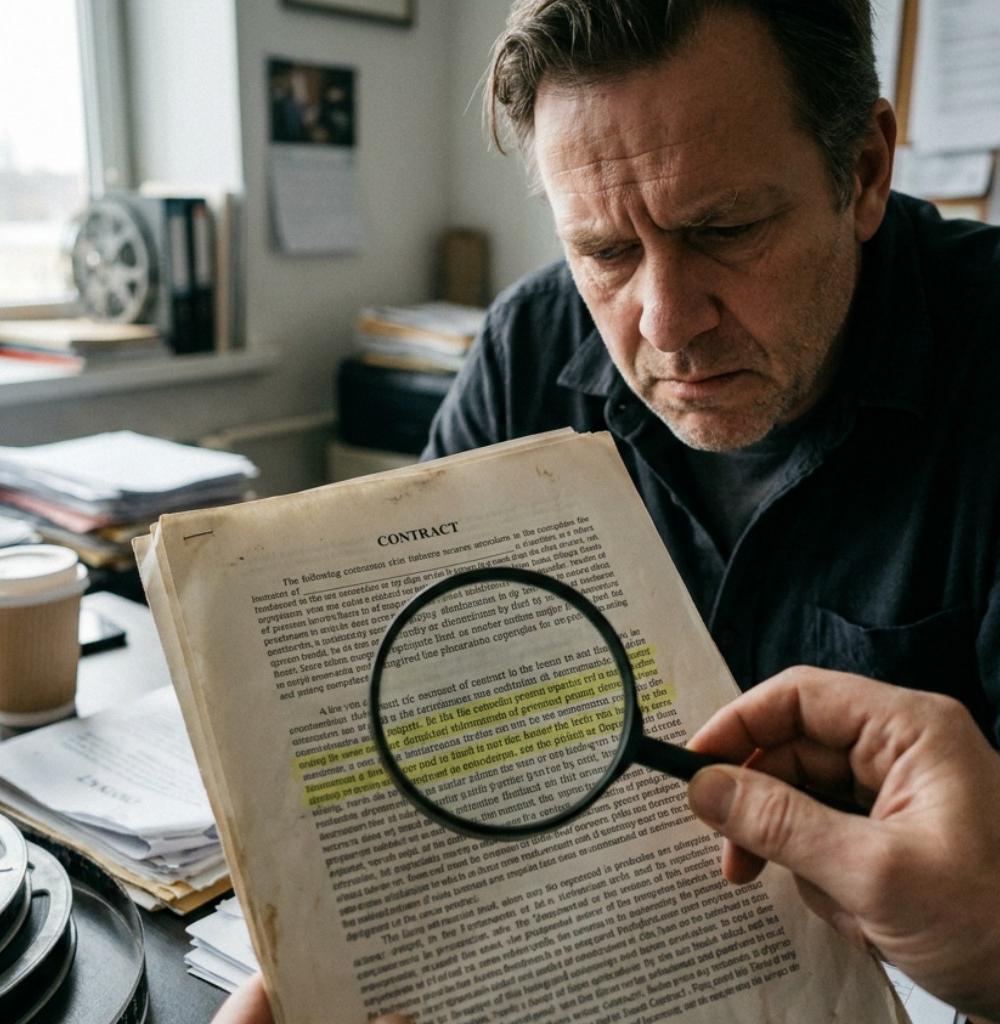
The contract clause that killed my film didn't look dangerous. It was four lines long, buried on page eleven of a location agreement, and it used the word "perpetual" in a context that seemed almost bureaucratic. Imagine a first-time director, project finished, festival circuit beginning — then a certified letter arrives. The location owner claims the right to block distribution because the agreement granted them approval over any "commercial exploitation" of footage shot on the premises. The film sits. The distributor walks. Two years of work, shelved by a clause that took thirty seconds to read and a lifetime to undo.
The direct answer: Most films don't die in development or on set. They die in paperwork — specifically in broadly worded approval rights, poorly defined territory clauses, music licensing gaps, and "in perpetuity throughout the universe" language that gets applied unevenly. Learn to spot six contract structures before you sign, and you keep creative control. Miss them, and someone else owns your story's future.
Why "Standard Contract" Is the Most Dangerous Phrase in Independent Film
There is no such thing as a standard contract. Every template you download from a filmmaking forum was written for someone else's project, in someone else's state, with someone else's risk tolerance. The phrase "this is our standard deal" is the entertainment industry's equivalent of "trust me." It means the terms benefit the person handing you the pen.
Independent filmmakers are especially vulnerable because they often negotiate without an entertainment attorney in the room. A full contract review from an experienced entertainment lawyer typically runs several hundred dollars — painful on a micro-budget, but cheap compared to a distribution hold or a copyright claim that can cost tens of thousands to litigate. The math is not close.
The enemy here isn't bad faith — most location owners, crew members, and even small distributors aren't trying to trap you. The enemy is vague language that nobody bothered to define clearly, and that vagueness becomes a weapon the moment any party's interests diverge from yours.
The Contract Clause That Killed My Film: Approval Rights
Approval rights are the single most common killer. They appear in location agreements, talent agreements with name actors, and co-production deals. The clause sounds reasonable: "Owner retains approval over the final edit as it pertains to use of the property." What it actually means: someone outside your creative team has a veto. Over your film.
The problem compounds when the approval right has no defined timeline. If the contract doesn't specify that approval must be given or withheld within, say, thirty days, the approving party can simply go silent. Silence becomes a permanent hold. You cannot distribute. You cannot submit to festivals that require cleared rights. You wait.
Fix it before you sign: define the scope narrowly ("approval over footage that directly identifies the property's exterior signage only"), set a response deadline with a deemed-approval clause ("failure to respond within 21 days constitutes approval"), and cap what they can object to. If they won't agree to those terms, find another location. Seriously.
The most dangerous contract clause isn't the one that takes your money — it's the one that takes your film's ability to exist in the world.
Territory and Term: The Clauses That Quietly Shrink Your Deal
Distribution contracts live and die on two variables: territory (where your film can be sold) and term (how long the distributor controls it). A predatory — or simply careless — distribution agreement will offer you "worldwide rights" on their side while giving you a term of fifteen to twenty-five years with no reversion clause. That means if they do nothing with your film, you cannot take it back and sell it elsewhere until your grandchildren are in middle school.
What to demand instead: a reversion clause tied to performance. Something like: "If the film does not achieve gross receipts of X dollars within 24 months of release, all rights revert to the producer." The specific number is negotiable — the concept is non-negotiable. Without it, you are giving a distributor a lottery ticket and asking them to be honest about whether it won.
Territory matters just as much. "Worldwide" in a distribution deal sounds powerful. It isn't, if the distributor only has relationships in three countries and sits on the rights for everywhere else. Consider splitting rights by territory — North America here, Europe there — so that inaction in one region doesn't block a sale in another. An active festival strategy can help you build the territory-specific buzz that gives you leverage to negotiate those splits.
Music Licensing Gaps: The Time Bomb in Your Edit
Picture this: you clear a song for "festival use." Your film gets into a major festival, then gets picked up. Now you need "all media, worldwide, in perpetuity" rights. The rights holder says yes — for a fee ten times what you originally paid, because they know you're stuck. This happens constantly, and it is entirely avoidable.
Sync licenses and master licenses are two separate clearances for the same song. Filmmakers routinely clear one and assume the other follows. It doesn't. If you license a recording without clearing the underlying composition (or vice versa), you have half a clearance and a lawsuit waiting to happen.
The cleanest solution on a micro-budget: commission original music or use composers who offer "all media" licenses up front, or work with music libraries that provide a single buyout license covering all distribution. It costs more at the start. It costs nothing later. Check out our deeper breakdown on pre-production legal checklists for a full sync-clearance workflow.
Chain of Title: The Document Your Distributor Will Ask For on Day One
Chain of title is the paper trail that proves you have the legal right to make and distribute your film. It includes your screenplay acquisition agreement, all writer's agreements, all underlying rights clearances, actor and crew releases, and any option agreements. Miss one link in that chain, and no legitimate distributor or errors-and-omissions insurer will touch your project.
The common mistake: filmmakers treat chain of title as a post-production problem. It is a pre-production problem. The moment you option a short story, adapt a true event, or cast someone whose life appears in the script, you need a paper trail. A handshake with a writer friend is not a chain-of-title document. An email that says "yeah go ahead and use it" is not a chain-of-title document. A signed agreement with a clear copyright assignment or license is.
Get your script's rights situation locked before you spend a dollar on production. Everything else — locations, cast, financing — is reversible. Chain of title gaps are not, once you're in the edit.
Co-Production and Investor Agreements: Who Controls the Cut?
Money comes with opinions. That's fine, as long as the contract defines exactly which opinions have legal weight. Co-production and investor agreements that grant "creative consultation rights" without defining what that means are ticking clocks. The moment a co-producer or an investor with 15% equity decides they hate your ending, you find out whether "consultation" means a phone call or a legal injunction.
Separate creative control from financial participation clearly and in writing. Investors get returns, reporting, and transparency — not a seat in the editing room. Co-producers who do have creative roles should have those roles defined with specificity: "Co-Producer has approval over casting of principal roles above a budget threshold of X." Vague equals dangerous. Specific equals protected.
Understanding your financing structure from the start also shapes how you approach grants and alternative funding — some grant agreements carry their own content or distribution restrictions that can conflict with a distributor's deal terms. Read every agreement in the same room, metaphorically speaking, before you sign any of them.
The Mistakes That Are Easiest to Avoid
- Signing a location agreement without a defined scope for "commercial use."
- Using a music track based on a YouTube license that does not cover film distribution.
- Accepting an oral agreement with a key crew member about ownership of footage they shoot.
- Filing for your LLC after production starts instead of before.
- Assuming an actor's release covers their performance and their likeness in perpetuity — these are often separate rights.
- Not reading the default and termination clauses of a distribution deal before celebrating the offer.
None of these mistakes require a villain. They just require someone who was too excited, too tired, or too trusting to read page eleven.
FAQ
Keep reading: Film Distribution Platforms: The Indie Guide, What Does a Film Distributor Do? A Clear Guide, and Deliverables That Kill Distribution Deals (And How to Fix Them).
Do I really need an entertainment lawyer for a micro-budget film?
Yes, even if it's just a one-hour contract review before you sign anything major. An entertainment attorney who works with independent filmmakers typically charges a few hundred dollars per hour — far less than the cost of a distribution dispute or a copyright claim. Many offer flat-fee packages for indie productions. Find one through your state film office's referral list or through film commission resources.
What is a reversion clause and why does it matter?
A reversion clause returns your film's rights to you if a distributor fails to meet defined performance benchmarks within a set timeframe — usually 18 to 36 months. Without one, a distributor who does nothing with your film can legally sit on the rights for the full contract term, which can be decades. Always negotiate for reversion. It is the single most important protection in any distribution deal.
What does "in perpetuity throughout the universe" actually mean?
It means forever, everywhere, including any future medium or platform that hasn't been invented yet. When you grant those rights, you grant them permanently. When a contract grants those rights to you — say, in a music license — that's ideal. When you're granting them to a distributor or a location owner, it should trigger immediate negotiation. The term and territory should always have a limit you can live with.
Can a crew member claim copyright in footage they shoot?
Yes, if you don't have a written work-for-hire agreement. Under U.S. copyright law, the person who creates a work owns it unless they've signed it over. A verbal deal or a simple invoice does not transfer copyright. Every DP, camera operator, and additional camera crew member should sign a work-for-hire agreement before they touch a camera on your set.
When should I start building my chain of title?
The day you decide to make the film — not after you finish shooting, not when a distributor asks. Start with the screenplay: get a signed agreement with any writer, confirm you have rights to any underlying material, and keep every contract in a single organized folder. Think of chain of title as your film's birth certificate. You can't prove it exists without one.
If you're building your first production or restructuring how you develop projects, FilmmakerGenius offers a free starting point — resources, templates, and a framework built specifically for independent filmmakers who want to get their films made and keep control of them. No upsell, no pressure. Just the tools you actually need at the stage you're actually in.
Your film survived the shoot. It survived the edit. Don't let page eleven of a contract be the thing that keeps it from the world. Read everything. Negotiate specifically. And treat your paperwork with the same creative ferocity you brought to every frame.