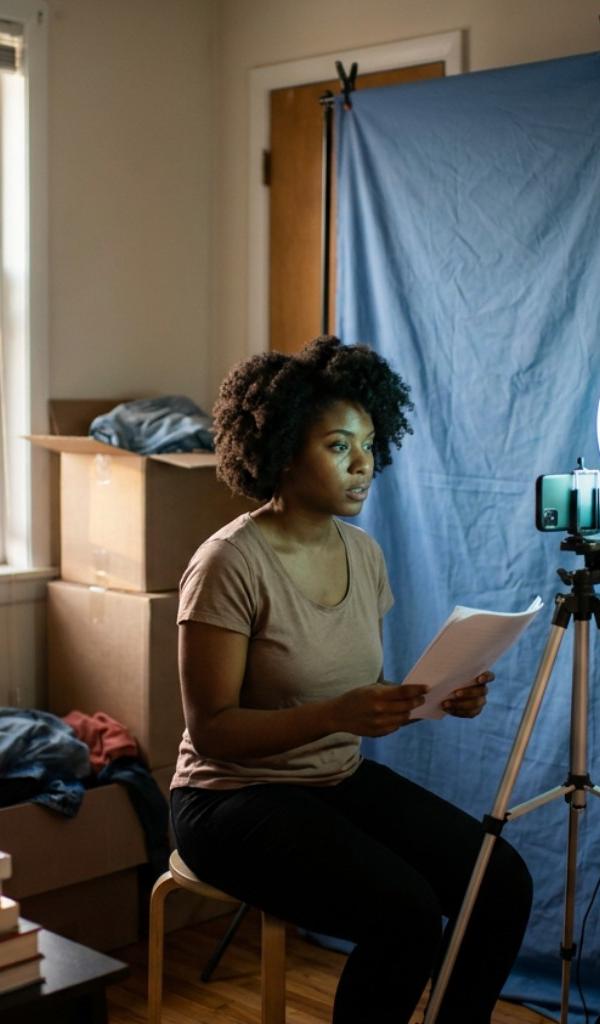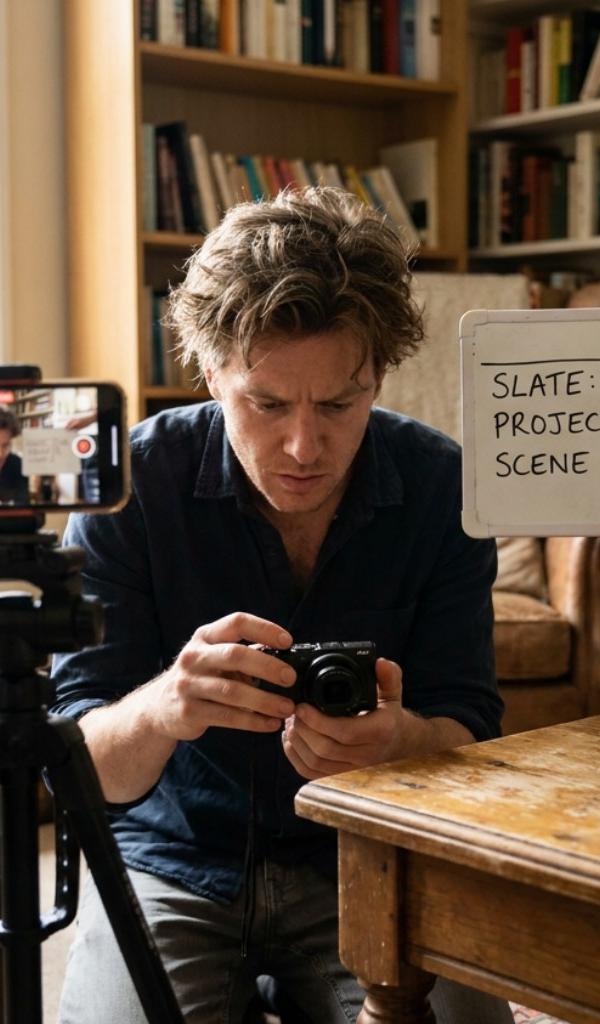
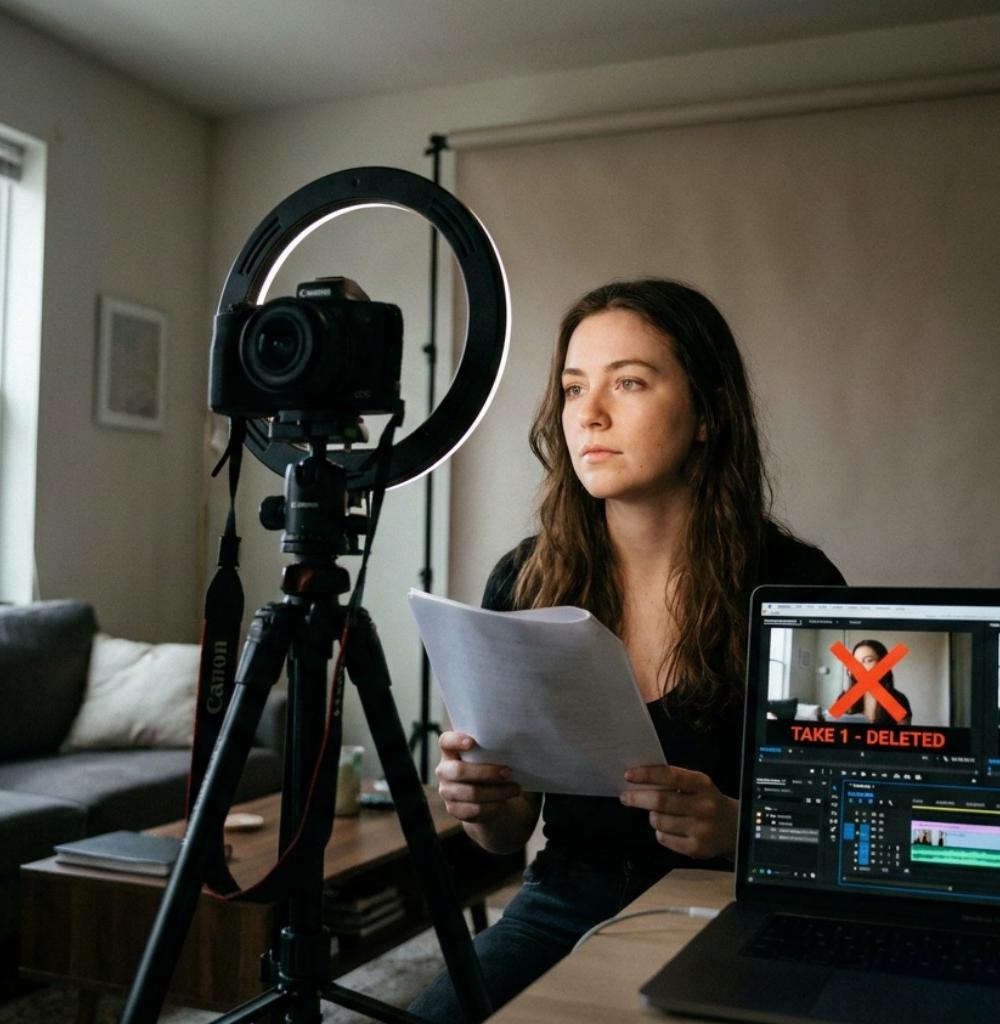
What makes a self-tape book isn't the lighting rig or the backdrop — it's a single variable that has nothing to do with the words. Here's the proof: three lines, the same three lines, handed to two different actors. "You told her." "I told her everything." "Then we're done." One tape gets deleted in two seconds; the other books the job. Same sides, two takes — and the difference is entirely in how each actor calibrated the performance to the lens. Let's watch both, then train it.
The line is fixed. Everyone gets the same words. The variable is you — and the variable is the whole audition.
Take One — Why It Gets Deleted
The first actor shoots alone the night before the deadline, running on adrenaline and a vague memory of "commitment." They open on "You told her" and lead with the emotion — big, accusing, eyebrows launched, head thrust forward, a hand slicing the air. "Then we're done" lands bigger: raised voice, a hard turn away for punctuation. On a stage, honestly, not bad. In a medium close-up, it's a person performing anger at a lens. The gestures leave the frame; the volume overloads the mic's intimacy; the face is doing so much there's no room left for the viewer to feel anything. Casting reads "trying" in two seconds. Delete. Not a talent problem — a calibration one.
Take Two — Watch Where the Acting Goes
Same three lines, different actor. "You told her" doesn't lead with anger — it leads with the thought: the exact instant of realizing that someone they trusted actually did it. So the line comes out quiet, almost calm, because the character is too stunned to be loud yet. The eyes do the work — a flicker of disbelief, the pupils searching for a "no" that isn't coming. Then the reader lands "I told her everything," and here's the move: the reaction is the performance. Before "Then we're done," a beat — a held stillness, a single caught breath, the jaw tightening on one muscle. The whole scene lives in that silent beat. "Then we're done" arrives quiet and final, sized down, not up, because a decision that heavy needs certainty, not volume.
That withheld thing behind the words is the moment casting leans forward. If you want the why underneath all of this — the mechanics of eyes, stillness, voice, gesture, face, and breath — it's laid out as a six-part method in the acting-for-camera guide in this section. This piece is the demonstration; that one is the manual.
The Reaction Beat Is the Job
Casting isn't watching your lips. They're watching what happens in your eyes the half-second before you speak and the full second after your scene partner finishes. The most common tape-killer is rushing that beat because it feels like dead air. It isn't dead — that beat is where they decide whether you're actually listening or just waiting to talk. Your reel gets you in the room; the reaction beat is what makes them call.
The Overcorrection Warning — Smaller Isn't Always Right
Hear "size down" and it's easy to produce something so microscopic it flatlines. Calibration isn't a law of "always smaller" — it's relative to medium, genre, and moment. A single-cam prestige drama wants the whisper-and-storm register. A multi-cam comedy wants brighter, quicker, more pop — still not stage-size, but not funereal either. A soap wants heightened turns. A horror scream is full-out, but it should come from truth and the body, not the throat and eyebrows. The skill isn't shrinking; it's matching — and it reshapes how you approach your audition strategy from the ground up.
The Five-Size Drill That Trains It
This builds the muscle deliberately instead of hoping instinct shows up on tape day. Take any two lines from real sides and run them at five sizes:
- Size 1 — Stage-big. Full projection, full physicality. Let it be theatrical.
- Size 2 — Presentational. Still a little large, still "performing."
- Size 3 — Natural. Conversational, like talking to a friend.
- Size 4 — Intimate. Quieter, more internal — camera three feet away.
- Size 5 — Eyes only. The thought, barely externalized.
Tape all five. Watch them back sound-off first, then with sound. You'll feel where "true for this lens" lives — almost always one or two clicks quieter on the outside and much louder on the inside than instinct wants. Run it on real sides for a month and you'll never send a bedroom take again.
Frequently Asked Questions
What actually makes one self-tape book over another with the same sides?
Calibration to the lens: a smaller, contained external performance carrying a fully committed internal life, plus a genuine reaction beat. Same words, different scale — and scale is the audition.
What is a reaction beat and why does it matter so much?
It's the moment after your partner speaks, before your next line, where the character processes what they heard. On tape it's often the strongest moment in the scene, because it proves you're actually listening. Never cut it short to avoid "dead air."
Does the right size change by genre?
Yes — that's the point. Prestige drama wants contained intensity; multi-cam comedy wants pop and speed; soap wants heightened turns. Match the register to the format before you record.
Can I run the five-size drill without a scene partner?
Absolutely. Use two lines from real sides, record every level, and watch back with honest eyes. You don't need a live reader — just a camera, a frame, and playback. Over time your body learns where "true for this lens" lives before you hit record.
If you want the technical environment that lets great calibrated work actually land — the right frame, light, and sound — start free at HowToSelfTape and stop letting setup get between casting and your best take.